Deep Dive on AI Book Spoofing on Amazon: Fakes targeting authors including Karen Swallow Prior and Kyla Scanlon

I originally learned about the AI book spoofing problem in mid-August when I was on Substack and came across a Substack note from Karen Swallow Prior complaining about fake books on Amazon coinciding with a book release (this is common in book spoofing, according to the Author's Guild). I have a background in financial crimes intelligence analysis and open-source intelligence analysis (OSINT) and I write about generative artificial intelligence risks, misuse. So, out of curiosity, I looked into Prior's claims. Then, in early October, I came across complaints by author Kyla Scanlon on X/Twitter dealing with the same issues and looked into those too.
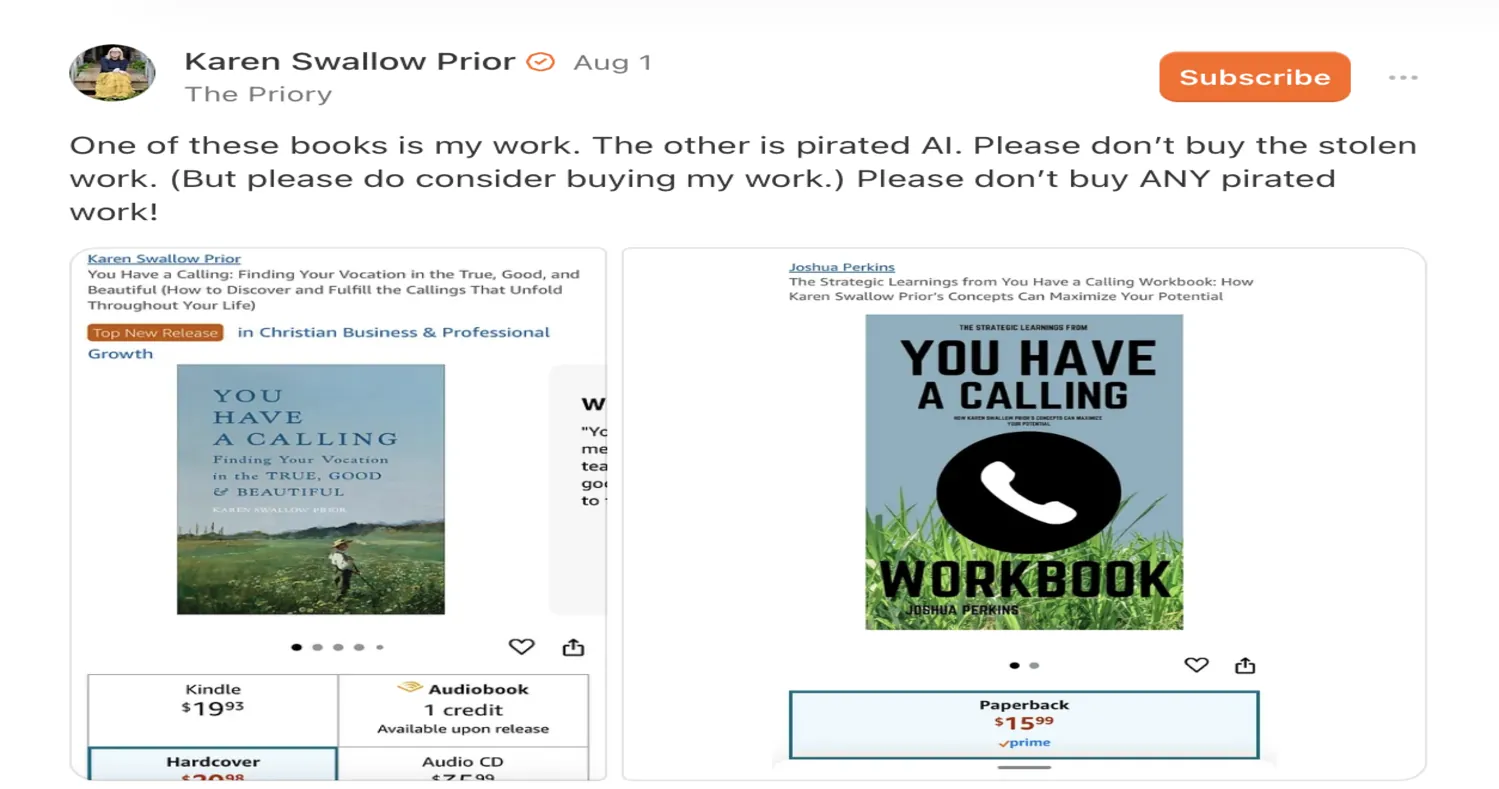
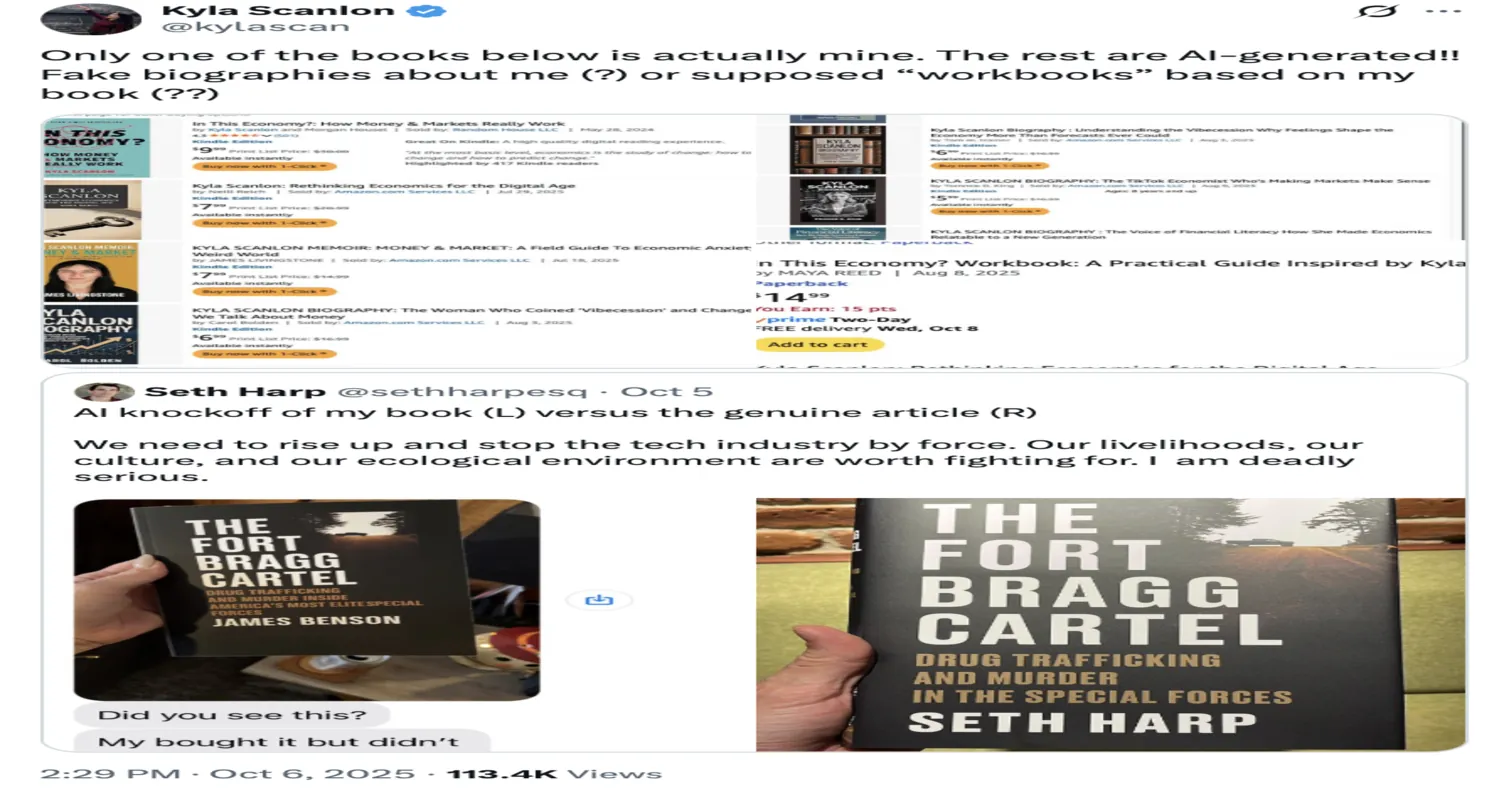
Targeted personalities included: authors Karen Swallow Prior, Andy Crouch (Tech-Wise Family), and Kyla Scanlon; athletes like Kevin Durant and Kylian Mbappé; journalists like Rukmini Callimachi and Christiane Amanpour; musicians like Zakk Wylde and Alan Jackson; actors like Pierce Brosnan and Scarlett Johansson; and comedians like Howie Mandel and Donald Glover.
In this post, I’ll lay out:
- What book spoofing is and what AI has to do with it
- What the book spoofing looked like for Karen Swallow Prior (and the other related targets)
- What the book spoofing looked like for Kyla Scanlon (and the other personalities targeted by the book spoofers)
- What might be done about this problem by book buyers (librarians, used bookstores, consumers), authors, agents, publishers, payment providers and e-commerce websites?
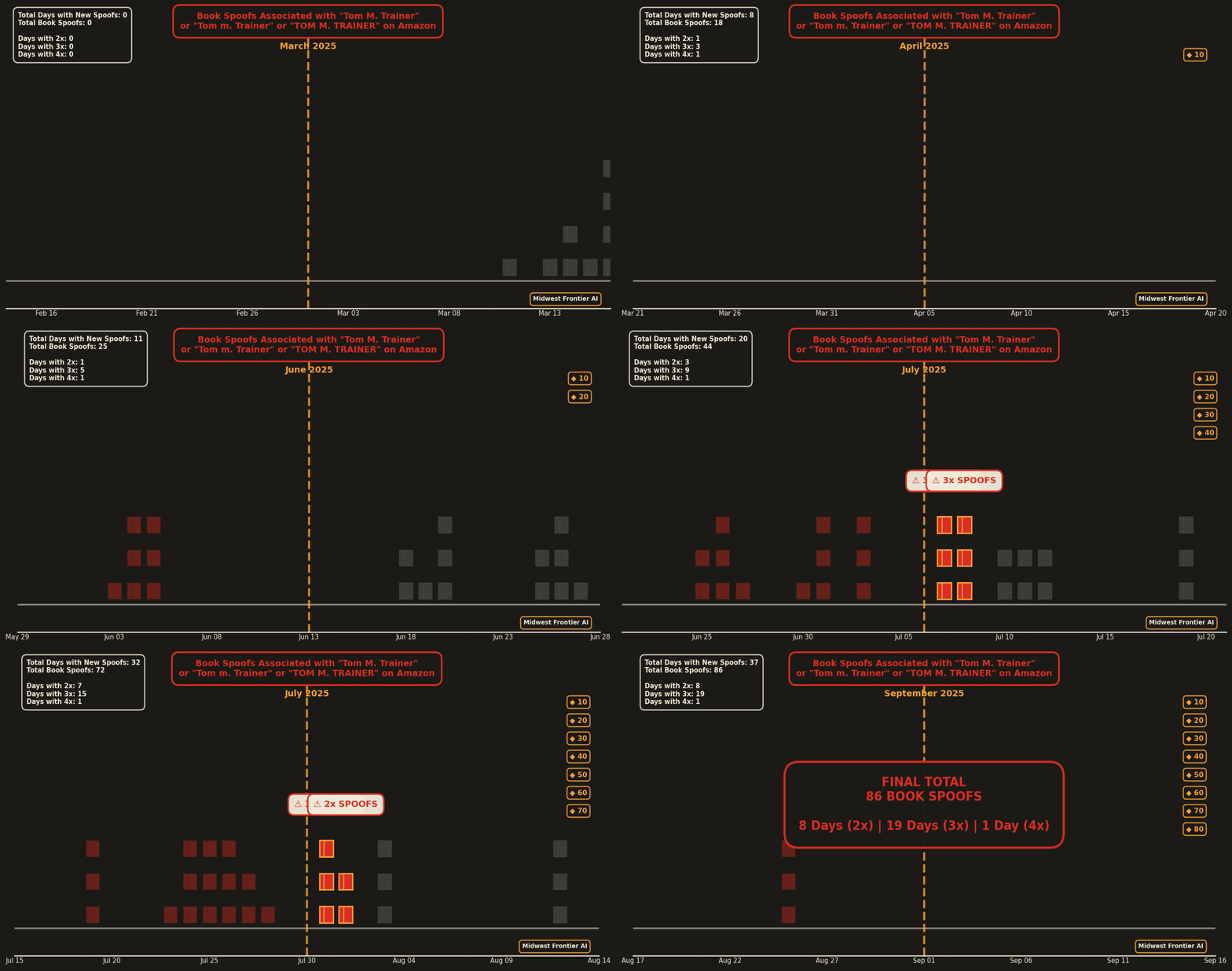
This post will explain in detail what I mean, but I think this image helps capture the volume.
I shared some of this information with Baker Publishing via email and Substack DMs in August and September. I did not get an acknowledgement, so I’m not sure if they saw it. If you know anyone over there, please feel free to share this with them.
I spoke with Scanlon’s agents at United Talent about initial observations in late October. Now I’m writing about this in more detail to help a broader audience of authors and other people in the publishing industry, librarians, and consumers, because I think this problem is likely to continue.
A note on my open-source intelligence (OSINT) collection. All of the data collection was done manually on a desktop browser while logged out of Amazon. I did not use any web scraping or other automation. Additionally, my own use of AI for this article was limited to using Claude to create some of the GIFs you’ll see to visualize the data I collected and documented manually. I manually verified the visualizations, which is important, because the first drafts the AI made hallucinated incorrect arithmetic. If this can happen with code grounded in numbers from a spreadsheet, imagine how unreliable Google’s NotebookLM “Infographic” feature is.
Amazon is currently suing Perplexity for the use of “agentic shopping” via its Comet browser’s automated access of Amazon accounts; while not weighing in on that specific lawsuit, I recommend that readers not use Perplexity AI’s Comet Browser for other reasons. There are major cybersecurity risks of agentic browsers in general and I have particular concerns about ads I have viewed from Perplexity targeted toward students that encourage academic dishonesty and claim the browser does not hallucinate, which is not accurate. Perplexity hallucinates false information like all LLM-powered AI tools.
Defining book spoofing
There isn’t a formal definition or even an agreement on what the term is, but here’s my take. Since there isn’t consensus, I think ”book spoofing” is a good name for the phenomenon because it covers a wide variety of scammy activity meant to piggyback on authors’ and other personalities’ work and fame to sell books to confused consumers. Book spoofs are:
-
low-effort, low-quality books now mainly made using AI (but books spoofing existed before consumer large language models)
- large language models (LLMs) for writing
- image generation for cover art; if not AI, then stock photos, images lifted from Wikipedia, or text on a solid color background
- images are often purportedly of the author or famous personality, but do not always look like the correct person
-
created to be sold on Amazon and other e-commerce website by piggybacking on search traffic using an author’s likeness or intellectual property:
- target’s name
- title of a new release
- title of a bestseller
-
These book spoofs are often sold through Kindle Direct Publishing.
-
These book spoofs are often framed as:
- “Workbooks” or “Summaries”
- “Biographies”
- According to an article in Rolling Stone from October 2025 about book spoofing, this is used to avoid takedowns by attempting to portray themselves as engaging in “fair use.”
-
The targeted author or other targeted personality’s name is often in the largest font on the cover.
- The book spoof “author’s” name is often in smaller font.
- The book spoof “author’s” name may be a throwaway alias.
-
The “authors” linked to these spoofs often have numerous books associated with them and have other book spoofs covering various genres.
-
The “author” linked to these spoofs publish in bursts of activity that do not appear to be consistent with human-generated writing (e.g., multiple books in the same day or on consecutive days or the same week).
According to NPR reporting, Amazon put a limit on the number of uploads per day. My question: why did Amazon apparently set the limit at more than one per day? Normal human writers simply do not have a new book to release every day, let alone two or three.
Other Coverage and Terminology
- Rolling Stone, Oct. 27, 2025: “AI Book Slop” and “AI knockoffs.”
- CBC, September 20, 2024: “Fake writers and AI-generated books” and “AI-generated rip-offs” and “scam books”
- Authors’ Guild, March 15, 2024: “Sham ‘Books’” and “scam books” and “‘companion’ books”
- NPR, March 13, 2024: “AI ‘scam’ books” and “copycat books”
- Wired, Jan. 10, 2024: “Scammy AI-Generated Book Rewrites”
“A few years ago, the Authors Guild, recognizing the impact these [companion] books can have on legitimate sales, convinced Amazon to require sellers of summary books to include a conspicuous disclaimer on the listing page and cover, disclosing that the book is a summary or guide and not a substitute for the original work.”
AI’s Role in Book Spoofing
Book spoofing apparently existed before the current era of generative AI. But now, the “remixing” of ripped off written content is likely rewritten with LLMs like ChatGPT.
If there is cover art, it is typically AI-generated. It has very generic imagery vaguely related to the targeted personality. For example, a spoof targeting Kyla Scanlon had a graph with font that had the sort of stereotypical default GPT-4o cartoon and font appearance.
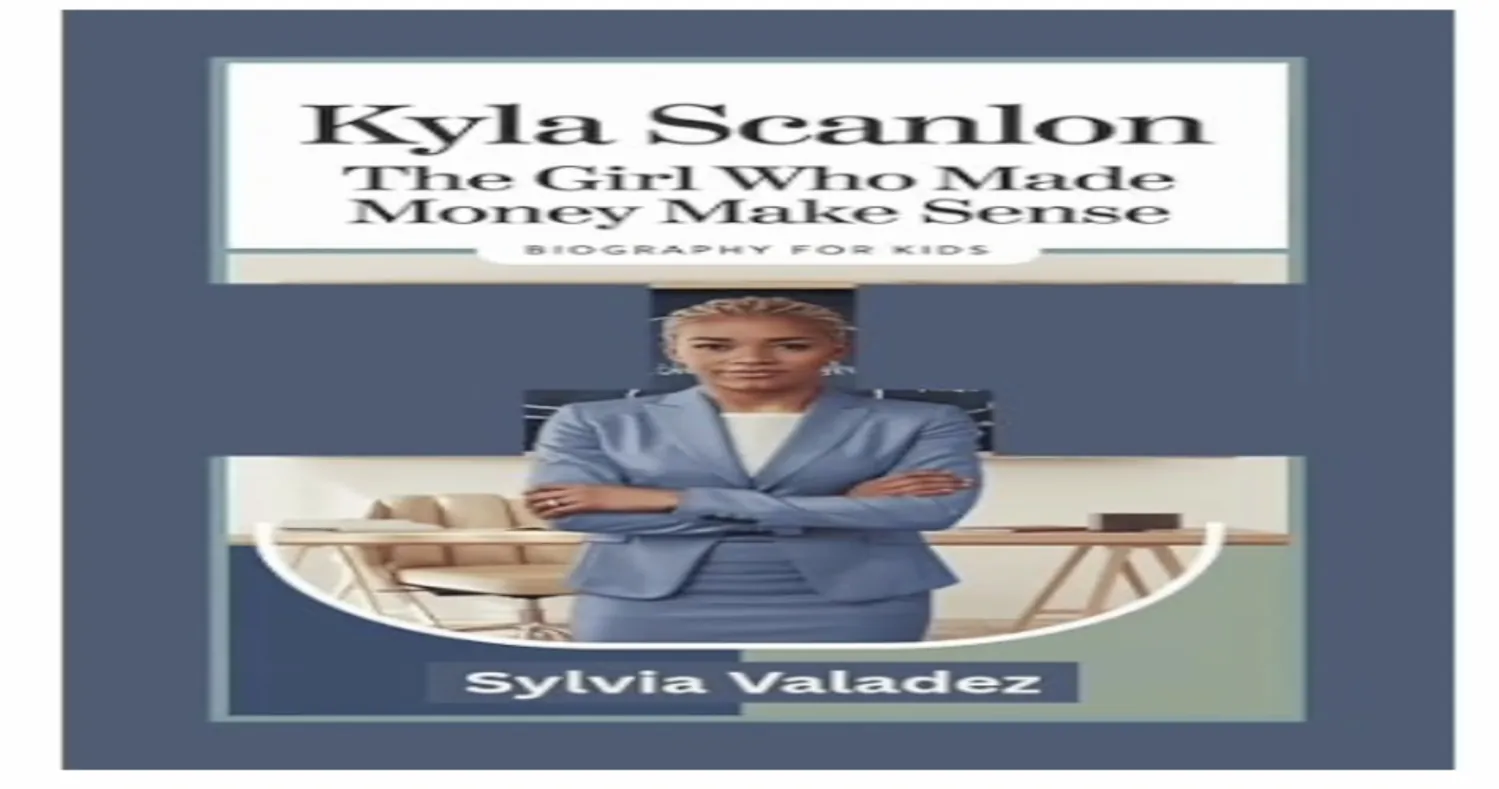
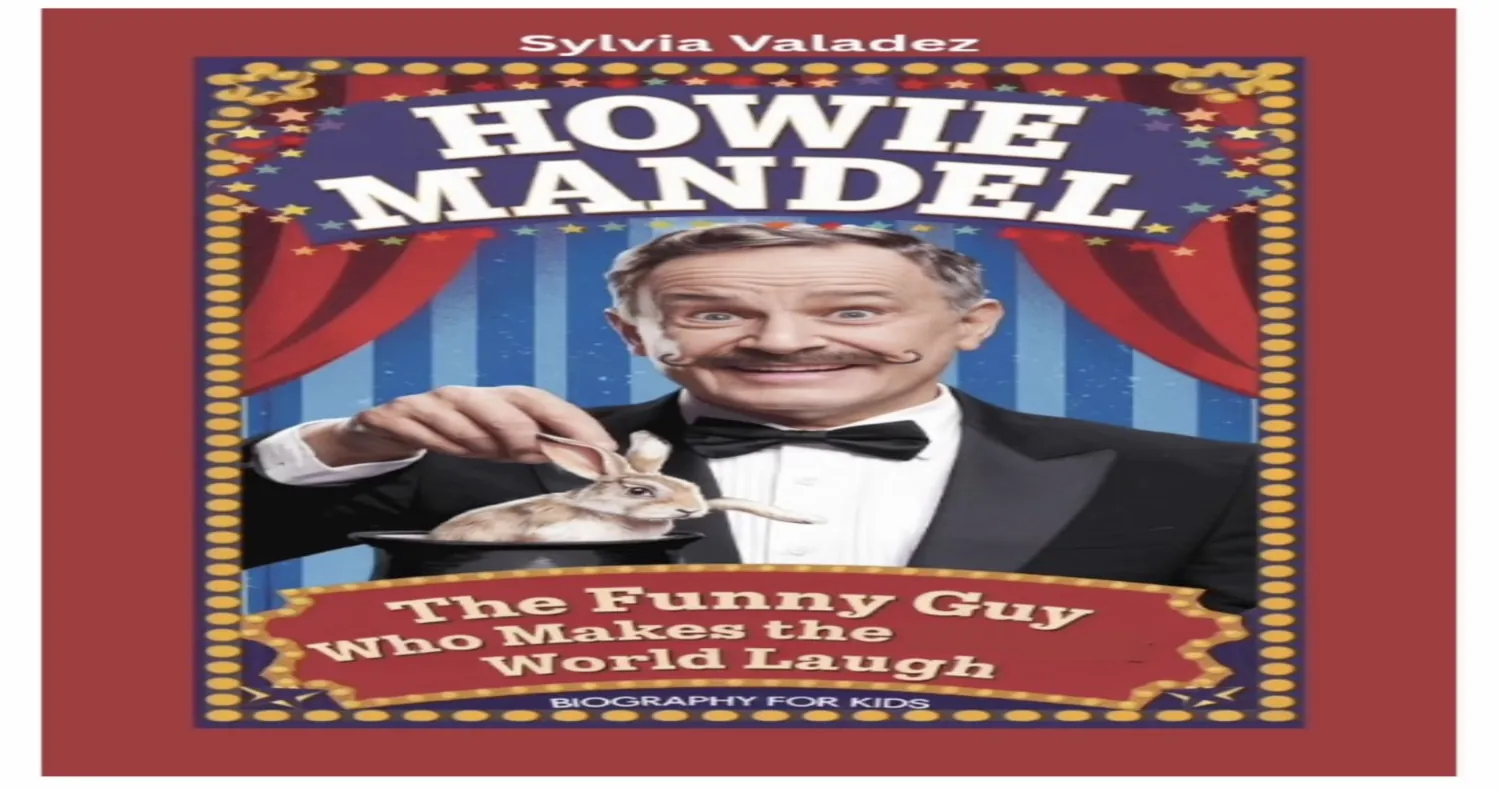
However, these spoofs do not always look like the targeted individual:
- For example a supposed biography spoof targeting Scanlon had a cover image with a black female.
- A biography spoof targeting bald comedian Howie Mandel had a generic carnival magician with hair pulling a rabbit out of a hat.
Spoofing Targeting Karen Swallow Prior and others
Karen Swallow Prior’s Substack Note
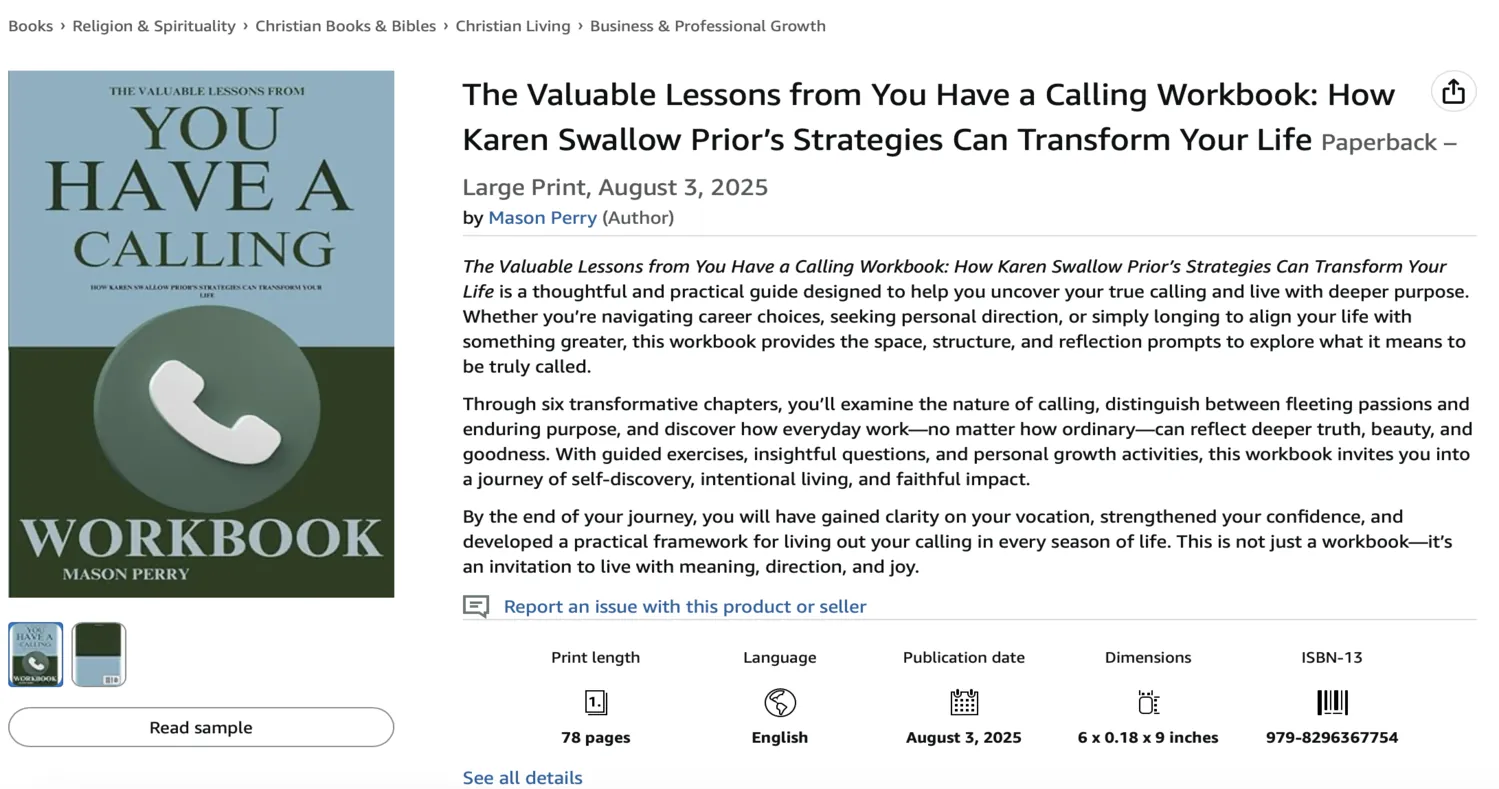
Previously, I had come across this Substack note by Karen Swallow Prior. The note itself was from August 1, 2025, mentioning that a fake AI-generated workbook was being sold on Amazon (by an author called "Joshua Perkins") and was spoofing Prior’s newly released book You Have a Calling. However, I did not see that Substack Note until the Substack algorithm randomly surfaced it for me sometime in mid-August. But out of curiosity, I searched Amazon to see if that fake was still available. It appears to have been taken down by then, but there was another book spoof targeting You Have a Calling and other book spoofs targeting books published by the same publisher.
Amazon Search for You Have a Calling
A similar spoof (by an author called "Mason Perry," likely a fake name riffing on "Perry Mason") had been uploaded on August 3 and it was still available nearly three weeks later.
Spoofing Targeting Baker’s Other Books
I looked at Baker Publishing's website for some titles of all-time best sellers and new releases. Based on searches for those titles, I found that in mid/late August there were also spoof "workbooks" on Amazon for:
- Tech-Wise Family [ironic]
- Imagine Heaven
- Help in a Hurry
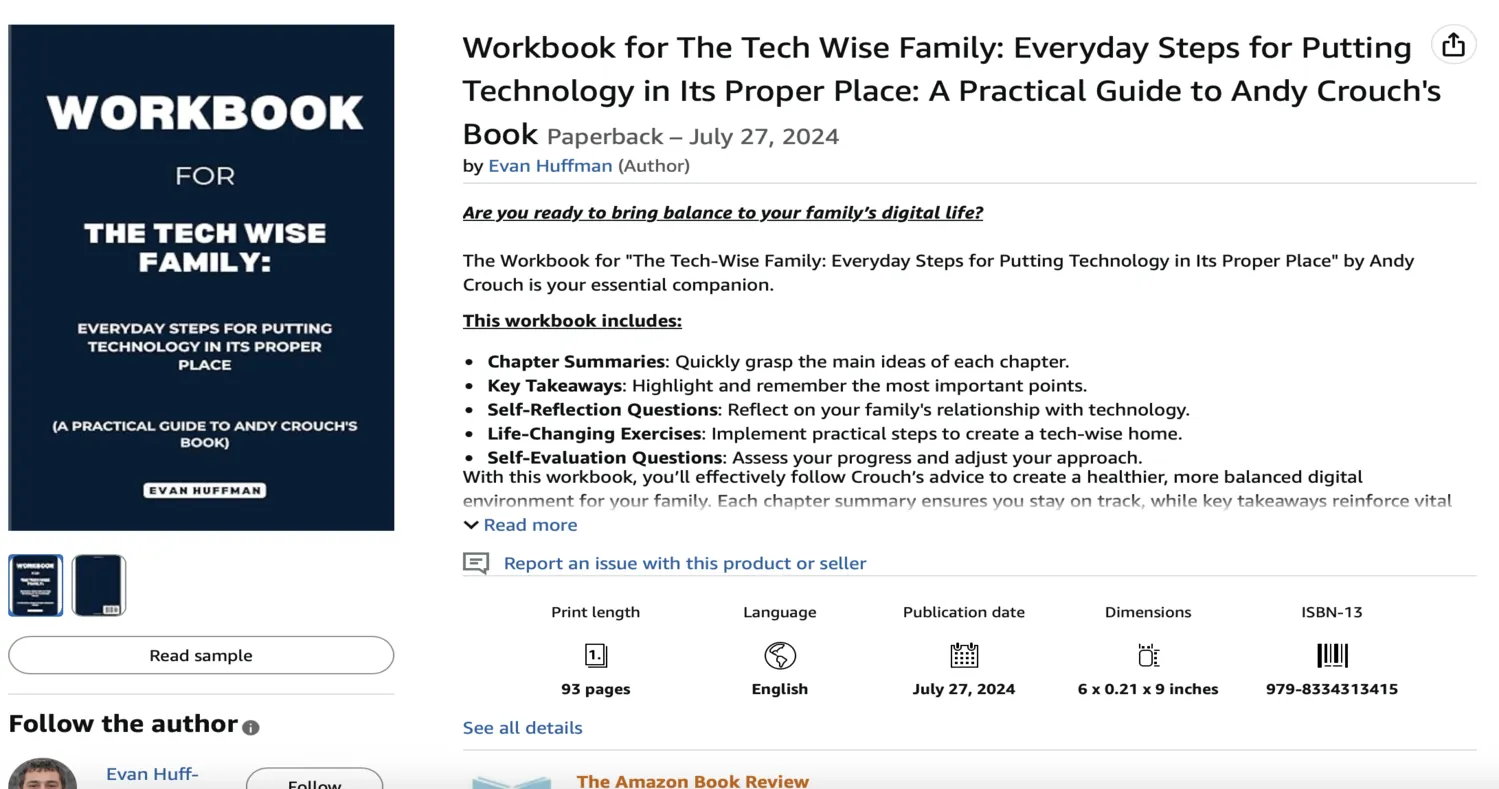
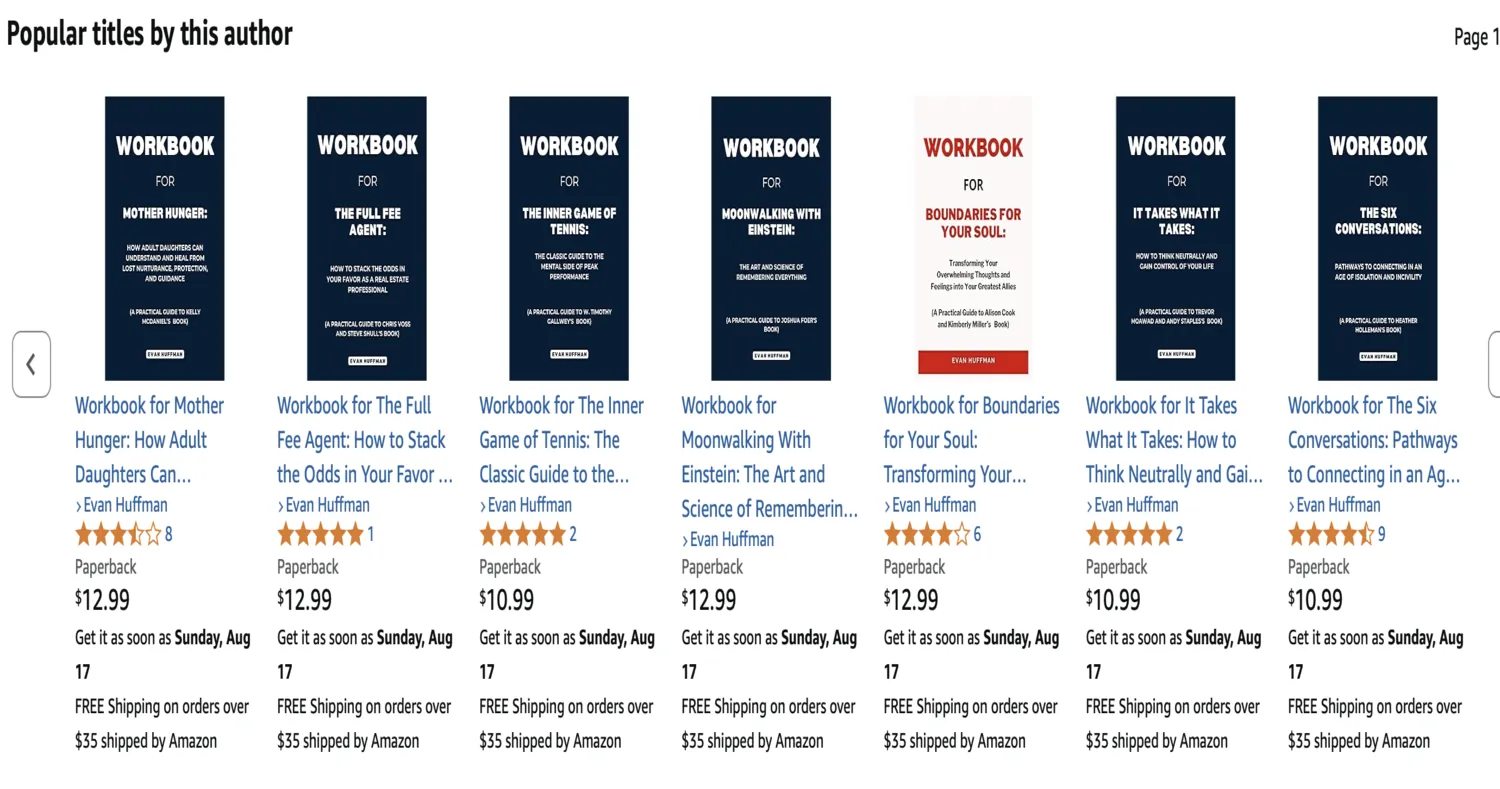
The apparent throwaway workbook authors’ accounts associated with the spoofs of the Baker Publishing books were also associated with a variety of fake workbooks spoofing multiple authors across unrelated genres, including:
- Christian non-fiction
- diet
- self-help
- popular business
- autobiography
This variety of genres is not inherently unusual on its own, but in combination with the low-quality cover art, the bursts of same-day activity, and the overall number of books, appears to be unlikely that any real, human author is creating these “workbooks” as legitimate content.
The various book spoofs and fake “authors” targeting Baker Publishing appear to have been taken down sometime this fall, although there are still some “book summary” spoofs on Amazon. While I took some screenshots of these posts in August, I was not thorough in documenting the number of book spoofs per “author” nor the number posted per day. So the next time, when I later saw complaints by author Kyla Scanlon, I made sure to type up a spreadsheet with the different book spoofs and date listed.
Spoofing Targeting Kyla Scanlon and Others
I saw Kyla Scanlon's X post in early October responding to another author who also noted the same problem of AI so-called "workbooks" and other AI spoofing of the authors on Amazon. As it turns out, Rolling Stone, later published an article about the latter author in late October 2025.
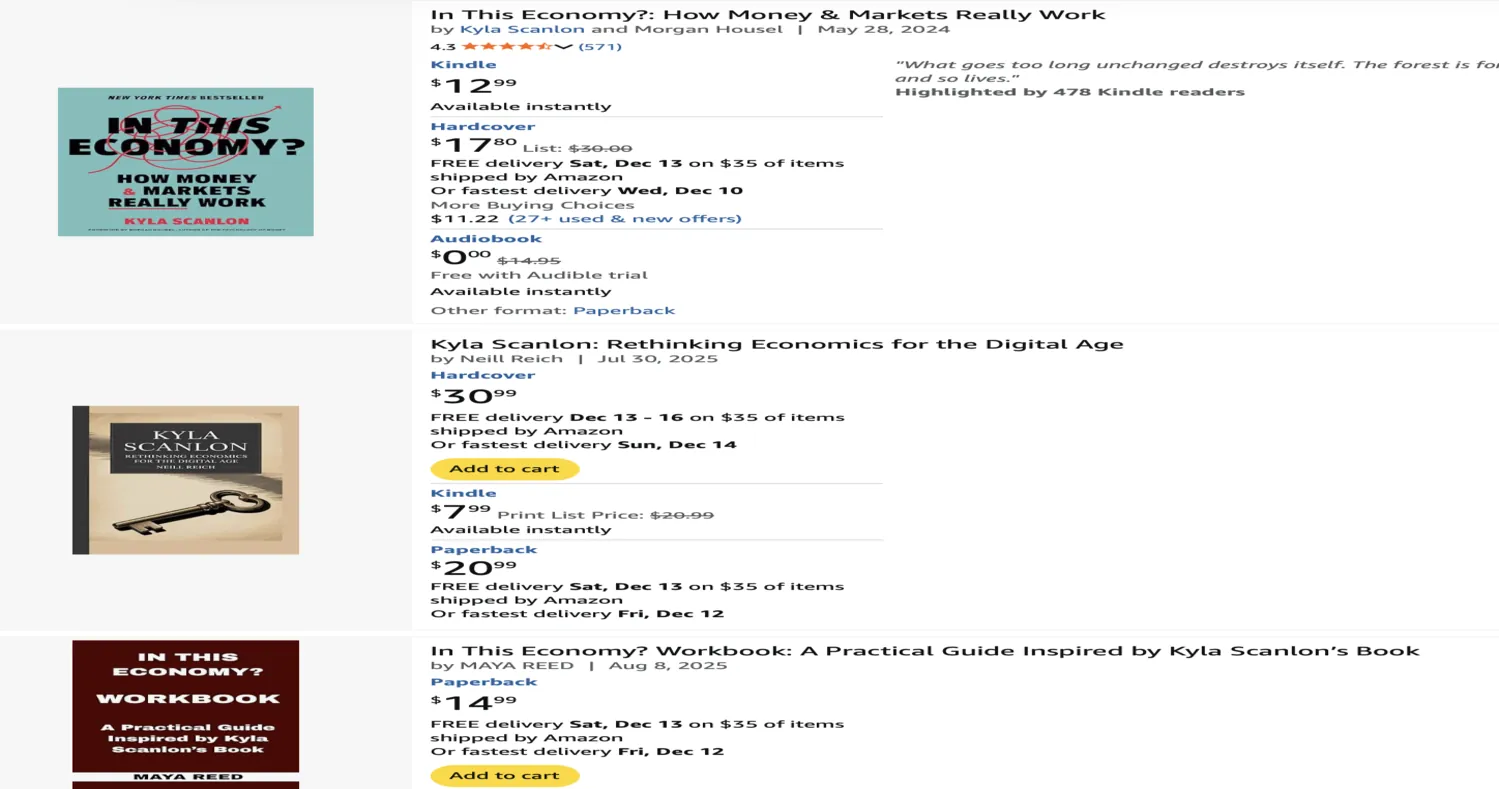
As of October 13, 2025, there were still a large number of so-called “workbooks” and so-called “biographies” referencing Kyla Scanlon or Kyla Scanlon’s book In This Economy? on Amazon. The book spoofs had clearly been churned out at an absurd rate. There were nine (9) groupings of fake author profiles I identified at that time targeting Scanlon and other personalities:
- “Neill Reich” targeted 16 personalities or books, including Scanlon, between July 27 and August 15. Some or all of these book spoofs are still available on Amazon as of December 8.
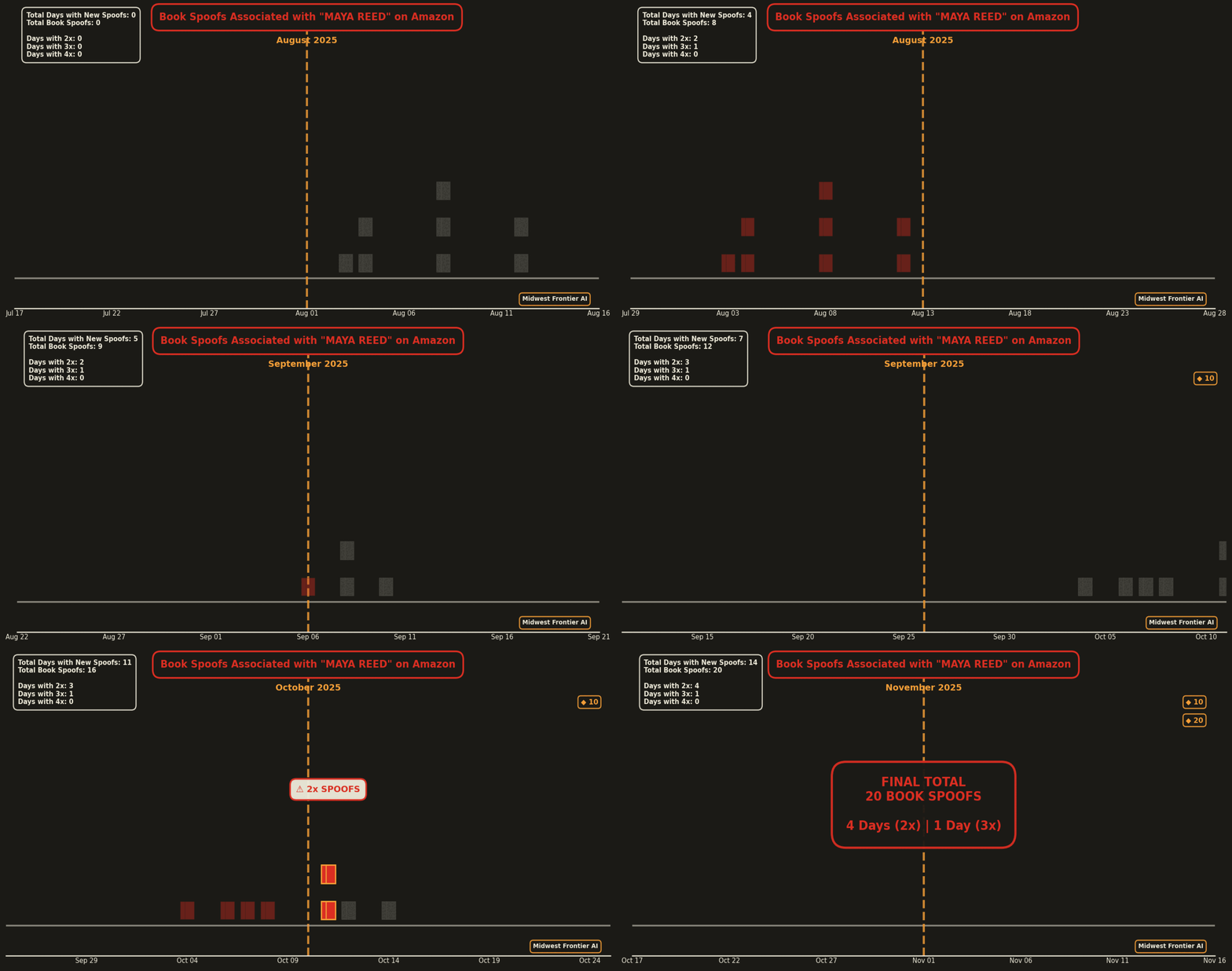
- “MAYA REED” targeted 20 personalities or books, including Scanlon, between August 3 and October 14; book spoofs had solid burgundy covered with large white font. Some or all of these book spoofs are still available on Amazon as of December 8.
- “Sylvia Valadez” targeted 69 personalities or books between July 10 and September 13, including Scanlon and two others on August 31. It appears that these spoofs have been removed from Amazon.
- “JAMES LIVINGSTONE” targeted only Scanlon on July 18. It appears that this spoof has been removed from Amazon.
- “Caitlin Madelyn” targeted six (6) personalities: one on July 5, one on August 3, three on August 4 (Kyla Scanlon, Rukmini Callimachi, and Sophie Raworth), and one on August 5. Some or all of these book spoofs are still available on Amazon as of December 8.
- “Tom m. trainer” or “TOM M. TRAINER” or “Tom m. trainer” collectively targeted 86 personalities or books, from March 11 to August 25; this included “Tom m. trainer” targeting Kyla Scanlon, Zakk Wylde, and Shams Charania on August 3. It appears that this spoof has been removed from Amazon.
- “Carol Bolden” and one more as “CAROL BOLDEN” targeted a total of 28 personalities or books, from July 17 to August 14; this included targeting Shams Charania and two others on August 2, Kyla Scanlon and one other on August 3, and Zakk Wylde and two others on August 4. Some or all of these book spoofs are still available on Amazon as of December 8.
- “Tommie D. king” or “Tommie D. King” or “TOMMIE D. King” collectively targeted 14 personalities or books between August 6 and August 9 including targeting Kyla Scanlon, Zakk Wylde, and Shams Charania on August 9. Rukmini Callimachi was targeted on August 8. Some or all of these book spoofs are still available on Amazon as of December 8.
- “Austin Mark” targeted only Scanlon on September 22. This book is still available on Amazon as of December 8.
Bursts of activity
Some of these "authors" had multiple books published on the same day, on consecutive days, or within the same week.
Spoofing Kyla Scanlon and other specific personalities on the same day or close days
There were odd overlaps across multiple fake “authors” posting book spoofs involving both Kyla Scanlon and other specific targets on the same day or consecutive days. For example, the
“Tom m. trainer” spoofed Kyla Scanlon, Zakk Wylde, and Shams Charania on August 3. Then, “Caitlin Madelyn” author spoofed Kyla Scanlon, Rukmini Callimachi, and Sophie Raworth on the following day. “Carol Bolden” spoofed Shams Charania on August 2, Kyla Scanlon on August 3, and Zakk Wylde on August 4. The “Tommie D. King” authors spoofed Rukmini Callimachi was targeted on August 8 and Kyla Scanlon, Zakk Wylde, and Shams Charania on August 9.
While not definitive on its own, the close timing in a single week in August and the apparent lack of connection between the targets leads me to believe that the multiple fake “authors” may be controlled by scammers with something in common. Perhaps there is one scammer controlling these multiple author profiles on Amazon. Or perhaps different scammers are using a similar spoofing automation tool, and by some quirk of the automation, it resulted in multiple scammers spoofing Scanlon, Wylde, Charania, and Callimachi on the same or consecutive days in early August. If I were at Amazon, this is the thread I would pull on to take down multiple high-volume book spoofers at once instead of playing whack-a-mole with individual spoofed books.
Low-quality cover art
Many of the cover images of the targeted celebrity clearly looked “off.” Some had AI-generated images (often with a “GPT-4o” look to the images). Some cover images were simply walls of text on a solid-color background. Some had semi-realistic images of the targets, but there was garbled text on sports jerseys and obvious characteristics of targets that did not match their biography (e.g., ethnicity, hair/baldness), indicating that the images were AI generated or otherwise pulled from stock image sources unrelated to the actual target.
Warnings and Potential Solutions
Book Buyers: Librarians, Used Bookstores, Consumers
Watch out for secondhand slop in physical form
The accounts associated with these books appeared to be sold mainly through Kindle Direct Publishing. Kindle Direct Publishing includes print on demand, which means consumers can receive a physical book.
Kindle Direct Publishing books can be printed on demand and a physical copy delivered to the consumer. If a scam victim is duped into buying a book spoof, they may not be comfortable throwing it away. They may instead try to donate or sell the book to a library, used bookstore, or thrift shop. Therefore, even consumers buying physical books could be exposed to buying these AI-generated books secondhand.
Authors and agents
Band together against common spoofers
If your book is being spoofed, chances are the same “author” is selling spoofs of others’ work too. So try to find those authors and work together to get the infringing material removed (as opposed to a single book listing).
Be careful what you wish for. Whatever content moderation you demand from Amazon and other e-commerce sites will be applied to everyone and may use the easiest, off-the-shelf AI solutions. My hunch is that focusing controls around the volume and speed of activity will be more effective at targeting spoofers but not real human authors entering the self-publishing market. If you start a witch hunt over “detecting” AI content in each ebook, you may end up with superficial features like emdash usage, words like “delve,” or the latest supposed AI detection algorithm flagging your own account.
Push back against the fig leaf of fair use “workbook” and “biography” framing by pointing out specifics
- These are low-quality products. Bursts of activity belie the claim that real effort was put into them. Don’t look at it book-by-book or author-by-author, but one-to-many view of spoofer-to-targets. Can an account legitimately create quality workbooks churning out 30 workbooks and biographies in a month?
- These book spoofs are meant to deceive the consumer. Point out the relative font size of the targeted, spoofed author’s name v. the purported author’s name on the cover and similar details.
- Check the ISBN and other details to see if they are real.
- Would a real, legitimate biography mix up basic biographical information like the appearance or ethnicity of the targeted personality on the cover art of book?
Publishers
The ecosystem is draining legitimate sales from your authors. It’s especially stealing their thunder during the key sales window when the products are new releases. Therefore, acting quickly is important. Assume book spoofs will be made of new releases and prepare ahead of time for how you will go after them. If you prepare for this situation strategically for your entire portfolio, it will give you more leverage than trying to put out fires for individuals authors and books when problems arise.
E-Commerce
Rather than play whack-a-mole with specific books being spoofed, look at the aggregate account activity. Is the “author” posting 30-80 books in a year? From what I have been able to find, the most prolific, successful (legitimate) self-published Kindle authors have a few dozen books spread across several years. So have you perhaps discovered a super-Brandon-Sanderson-Stephen-King-Nora-Roberts-James-Patterson? Or is it more likely this is AI slop being churned out to spoof legitimate authors?
Look at commonalities between different book spoof “authors.” Are there common targeted personalities during certain time periods (like the Scanlon-Charania-Callimachi-Wydle Cluster in early August 2025)? Find other accounts targeting these individuals.