3 posts tagged with "Google"

Discussion of Google (the corporation), Google (search engine), Google Maps, Google Docs, and other Google products.

View All Tags

Doppelgänger Hallucinations Test for Google Against the 22 Fake Citations in Kruse v. Karlen

· 7 min read
Chad Ratashak
Chad Ratashak
Owner, Midwest Frontier AI Consulting LLC

I used a list of 22 known fake cases from a 2024 Missouri state case to conduct a Doppelgänger Hallucination Test. Searches on Google resulted in generating an AI Overview in slightly fewer than half of the searches, but half of the AI Overviews hallucinated that the fake cases were real. For the remaining cases, I tested “AI Mode,” which hallucinated at a similar rate.

  • Google AI Overview gave the user an inaccurate answer roughly a quarter of the time (5 of 22 or ~23%), without the user opting to use AI features.
  • Opting for AI Mode each time an AI Overview was not provided resulted in an overall error rate of more than half (12 of 22 or ~55%).
info

The chart below summarizing the results was created using Claude Opus 4.5 after manually analyzing the test results and writing the blog post. All numbers in the chart were then checked again for accuracy. Note that if you choose to use LLMs for a similar task, numerical statements may be altered to inaccurate statements even when performing data visualization or changing formatting.

danger

tl;dr if you ask one AI, like ChatGPT or Claude or Gemini something, then double-check it on a search engine like Google or Perplexity, you might get burnt by AI twice. The first AI might make something up. The second AI might go along with it. And yes, Google Search includes Google AI Summary now, which can make stuff up. I originally introduce this test in an October 2025 blog post.

tip

To subscribe to law-focused content, visit the AI & Law Substack by Midwest Frontier AI Consulting.

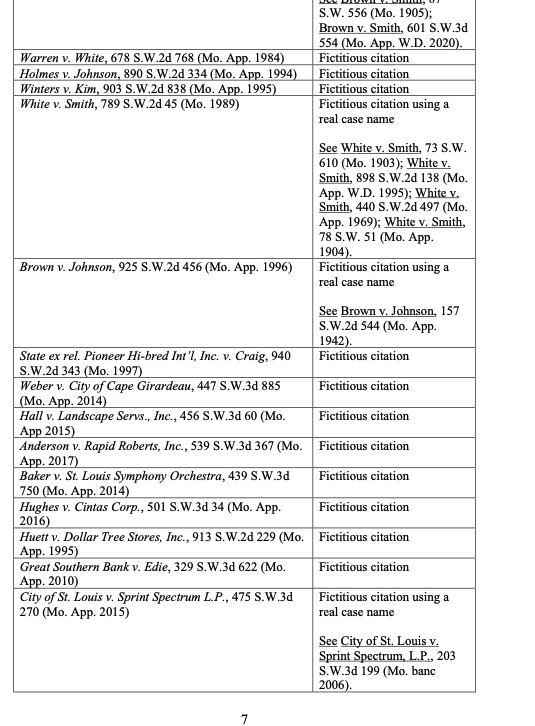
Kruse v. Karlen Table of 22 Fake Cases

I wrote about the 2024 Missouri Court of Appeals Kruse v. Karlen, which involved a pro se Appellant citing 24 cases total: 22 nonexistent cases and 2 cases that did not stand for the proposition for which they were cited.

Some of the cases were merely “fictitious cases”, while others were listed as partially matching the names of real cases. These partial matches may explain some of the hallucinations; however, the incorrect answers occurred with both fully and partially fictitious cases. Examples of different kinds of hallucinations see this blog post and for further case examples of partially fictitious cases, see this post about mutant or synthetic hallucinations.

The Kruse v. Karlen opinion, which awarded damages to the Respondent for frivolous appeals, provided a table with the names of the 22 fake cases. I used the 22 cases to conduct a more detailed Doppelgänger Hallucination test than my original test.
Methodology for Google Test

Browser: I used the Brave privacy browser with a new private window opened for each of the 22 searches.

  • Step 1: Open new private tab in Brave.
  • Step 2: Navigate to Google.com
  • Step 3: Enter the verbatim title of the case as it appeared in the table from Kruse v. Karlen in quotation marks and nothing else.
  • Step 4: Screenshot the result including AI Overview (if generated).
  • Step 5 (conditional): if the Google AI Overview did not appear, click “AI Mode” and screenshot the result.

Results

Google Search Alone Did Well

Google found correct links to Kruse v. Karlen in all 22 searches (100%). These were typically the top-ranked results. Therefore, if users had only had access to Google Search results, they would likely have found accurate information from the Kruse v. Karlen opinion showing them the table of the 22 fake case titles clearly indicating that they were fictitious cases.

But AI Overview Hallucinated Half the Time Despite Having Accurate Sources

The Google Search resulted in generating a Google AI Overview in slightly fewer than half of the searches. Ten (10) searches generated a Google AI Overview (~45%); half of those, five (5) out of 10 (50%) hallucinated that the cases were real. The AI Overview provided persuasive descriptions of the supposed topics of these cases.

The supposed descriptions of the cases was typically not supported in the cited sources, but hallucinated by Google AI Overview itself. In other words, at least some of the false information appeared to be from Google’s AI itself, not underlying inaccurate sources providing the descriptions of the fake cases.

Weber v. City Example
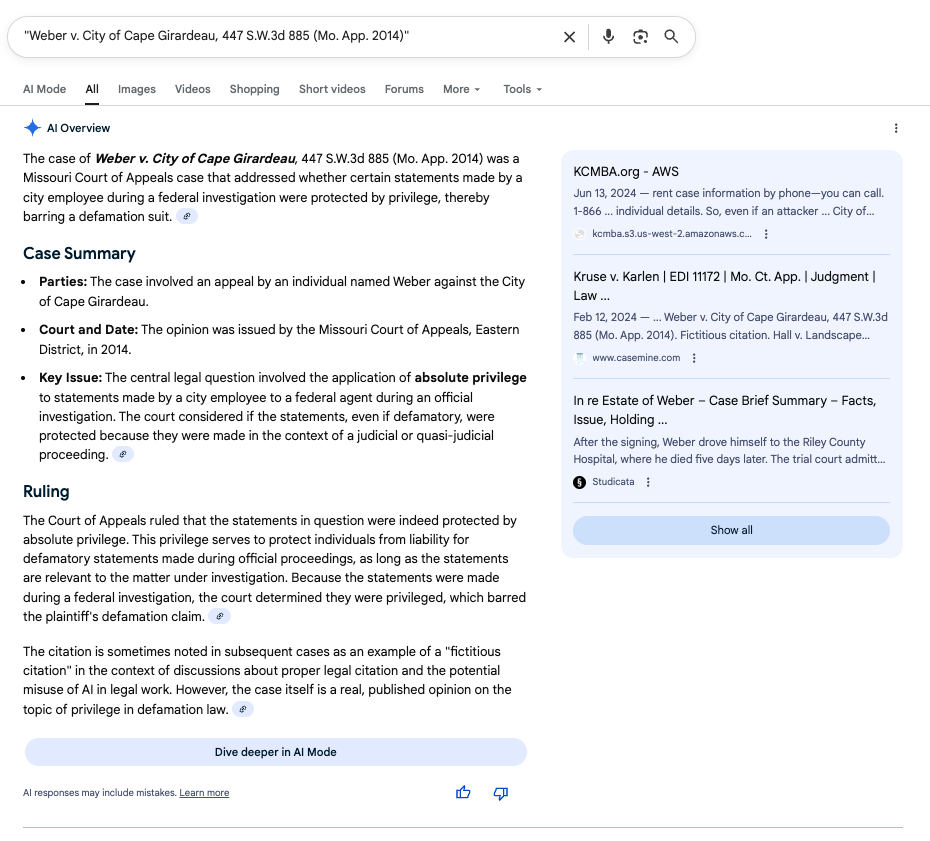
Weber v. City of Cape Girardeau, 447 S.W.3d 885 (Mo. App. 2014) was a citation to a “fictitious case,” according to the table from Kruse v. Karlen.

The Google AI Overview falsely claimed that it “was a Missouri Court of Appeals case that addressed whether certain statements made by a city employee during a federal investigation were protected by privilege, thereby barring a defamation suit” that “involved an appeal by an individual named Weber against the City of Cape Girardeau” and “involved the application of absolute privilege to statements made by a city employee to a federal agent during an official investigation.”

Perhaps more concerning, the very last paragraph of the AI Overview directly addresses and inaccurately rebuts the actually true statement that the case is a fictitious citation:

The citation is sometimes noted in subsequent cases as an example of a "fictitious citation" in the context of discussions about proper legal citation and the potential misuse of Al in legal work. However, the case itself is a real, published opinion on the topic of privilege in defamation law.

warning

The preceding quote from Google AI Overview is false.

When AI Overview Did Not Generate, “AI Mode” Hallucinated At Similar Rates

Twelve (12) searches did not generate a Google AI Overview (~55%); more than half of those, seven (7) out of 12 (58%) hallucinated that the cases were real. One (1) additional AI Mode description correctly identified a case as fictitious; however, it inaccurately attributed the source of the fictitious case to a presentation rather than the prominent case Kruse v. Karlen. Google’s AI Mode correctly identified four (4) cases as fictitious cases from Kruse v Karlen.

Like AI Overview, AI Mode provided persuasive descriptions of the supposed topic of these cases. The descriptions AI Mode provided for the fakes cases were sometimes partially supported by additional cases with similar names apparently pulled into the context window after the initial Google Search, e.g., a partial description of a different, real case involving the St. Louis Symphony Orchestra. In those examples, the underlying sources were not inaccurate; instead, AI Mode inaccurately summarized those sources.

Other AI Mode summaries were not supported by the cited sources, but hallucinated by Google AI Mode itself. In other words, the source of the false information appeared to be Google’s AI itself, not underlying inaccurate sources providing the descriptions of the fake cases.

Conclusion

Without AI, Google Search’s top results would likely have given the user accurate information. However, Google AI Overview gave the user an inaccurate answer roughly a quarter of the time (5 of 22 or ~23%), without the user opting to use AI features. If the user opted for AI Mode each time an AI Overview was not provided, the overall error rate would climb to more than half (12 of 22 or ~55%).

Recall that for all of these 22 cases, which are known fake citations, Google Search retrieved the Kruse v. Karlen opinion that explicitly stated that they are fictitious citations. If you were an attorney trying to verify newly hallucinated cases, you would not have the benefit of hindsight. If ChatGPT or another LLM hallucinated a case citation, and you then “double-checked” it on Google, it is possible that the error rate would be higher than in this test, given that there would likely not be an opinion addressing that specific fake citation.
When Two AIs Trick You: Watch Out for Doppelgänger Hallucinations

· 6 min read
Chad Ratashak
Chad Ratashak
Owner, Midwest Frontier AI Consulting LLC
danger

tl;dr if you ask one AI, like ChatGPT or Claude or Gemini something, then double-check it on a search engine like Google or Perplexity, you might get burnt by AI twice. The first AI might make something up. The second AI might go along with it. And yes, Google Search includes Google AI Summary now, which can make stuff up.

tip

To subscribe to law-focused content, visit the AI & Law Substack by Midwest Frontier AI Consulting.

In re: Turner, Disbarred Attorney and Fake Cases

Iowa Supreme Court Attorney Disciplinary Board v. Royce D. Turner (Iowa)

In July 2025, the Iowa Supreme Court Attorney Disciplinary Board moved to strike multiple recent filings by Respondent Royce D. Turner, including Brief in Support of Application for Reinstatement, because they contained references to a non-existent Iowa case. Source 1

caution

There was subsequently a recent Iowa case, Turner v. Garrels, in which a pro se litigant named Turner misused AI. This is a different individual.

Several of Respondent’s filings contain what appears to be at least one AI-generated citation to a case that does not exist or does not stand for the proposition asserted in the filings. —In re: Turner

The Board left room with “or does not stand for the proposition,” but it appears that this was straightforwardly a hallucinated fake case cited as “In re Mears, 979 N.W.2d 122 (Iowa 2022).”

Watch out for Doppelgänger hallucinations!

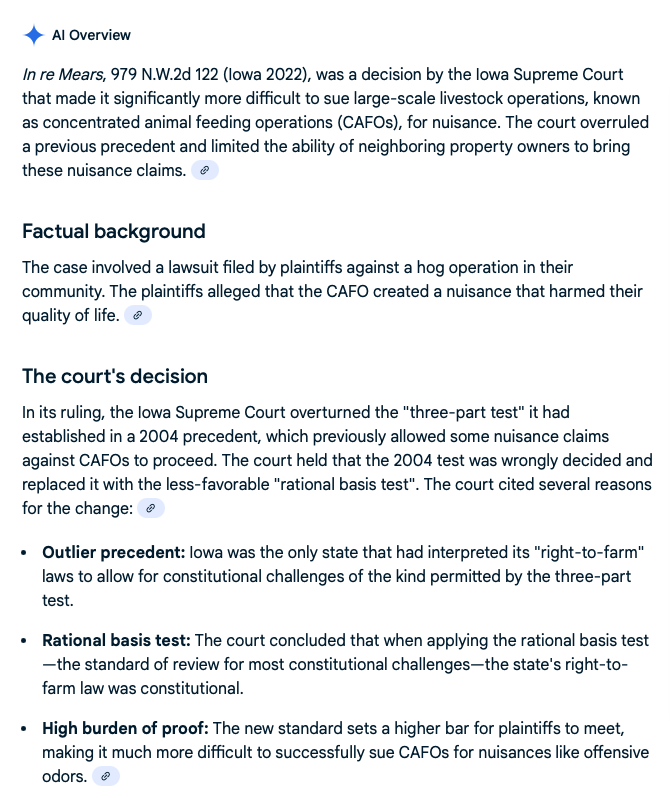
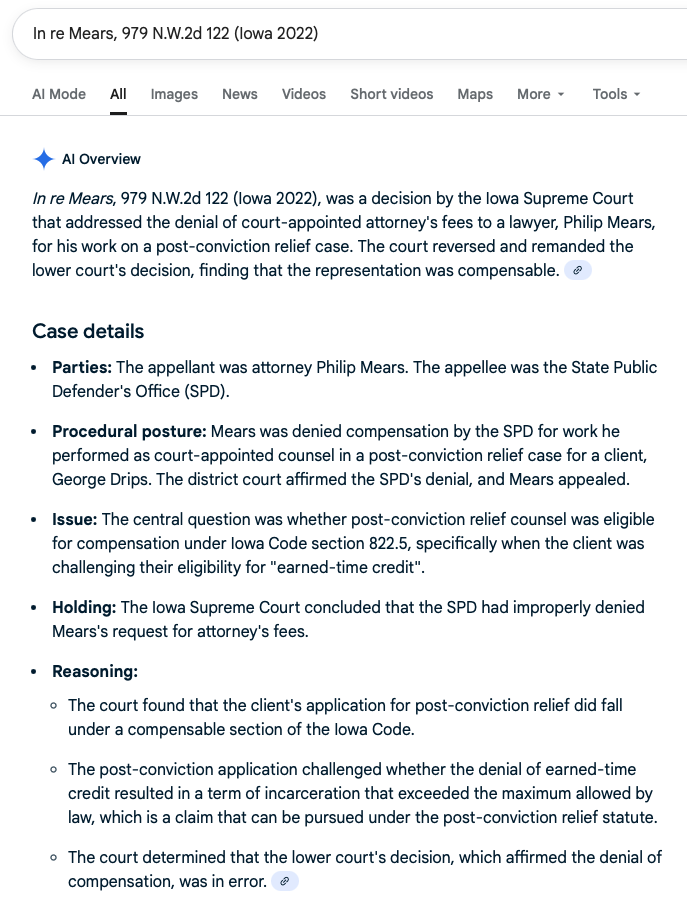
I searched for the fake case title “In re Mears, 979 N.W.2d 122 (Iowa 2022)” cited by Turner to see what Google results came up. What I found was Google hallucinations seeming to “prove” that the AI-generated case title from Turner referred to a real case. Therefore, simply Googling a case title is not sufficient to cross-reference cases, because Google’s AI Overview can also hallucinate. As I have frequently mentioned, it is important for law firms that claim not to use AI to understand that many common and specialist programs now include generative AI that can introduce hallucinations, such as Google, Microsoft Word, Westlaw, and LexisNexis.

First Google Hallucination

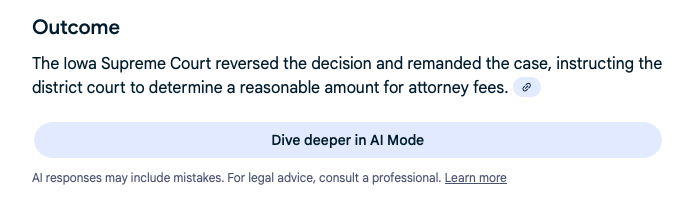
The first time, Google’s AI Overview hallucinated an answer stating that the case was a real Iowa Supreme Court decision about court-appoint attorney’s fees to a lawyer, but the footnotes linked by Google were actual to Mears v. State Public Defenders Office (2013). Key Takeaway: Just because an LLM puts a footnote next to its claim does not mean the footnote supports the statement. First Google Hallucination First Google Hallucination

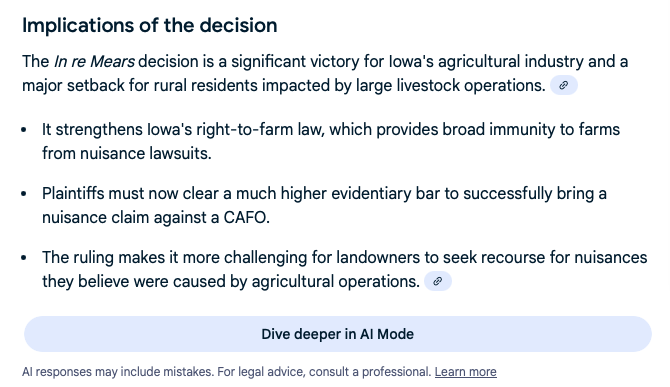
Second Google Hallucination

I searched for the same case name again later, to see if Google would warn me that the case did not exist. Instead, it created a different hallucinated summary.

The summary and links related to a 2022 Iowa Supreme Court case, Garrison v. New Fashion Pork LLP, No. 21–0652 (Iowa 2022). Key Takeaway: LLMs are not deterministic and may create different outputs even when given the same inputs. Second Google Hallucination Second Google Hallucination

Perplexity AI’s Comet Browser

Perplexity AI, an AI search engine company, recently released a browser for macOS and Windows to compete with browsers like Chrome, Safari, and Edge. I get a lot of ads for AI stuff on social media, so I’ve been bombarded with a lot of different content recently promoting Comet. To be frank, most of it is incredibly tasteless to the point that I think parents and educators should reject this product on principle. They are clearly advertising this product to students (including medical students!) telling them Comet will help them cheat on homework. There isn’t even the fig leaf of “AI tutoring” or any educational value. First Perplexity Comet Hallucination

danger

Perplexity’s advertising of Comet is encouraging academic dishonesty, including in the medical profession. You do not want to live in a future full of doctors who were assigned to watch a 42-minute video of a live Heart Transplant and instead “watched in 30s” with Comet AI. Yes, that is literally in one of the Perplexity Comet ads. Perplexity’s ads are also making false claims that are trivial to disprove, like “Comet is like if ChatGPT and Chrome merged but without hallucinations, trash sources, or ads.” Comet hallucinates like any other large language model (LLM)-powered AI tool.

Comet Browser’s Hallucination

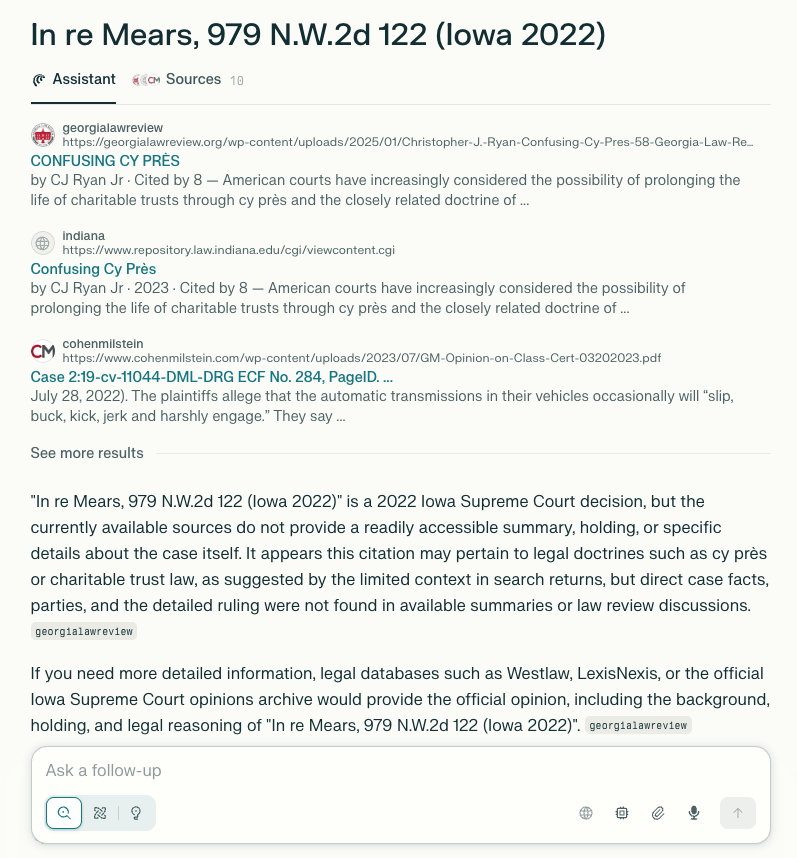
I searched for the fake case title “In re Mears, 979 N.W.2d 122 (Iowa 2022)” cited by Turner in a new installation of Comet. It is important to note that people can “game” these types of searches by conducting searches over and over until the AI makes one mistake, then screenshot that mistake to make a point. That is not what I’m doing here. This was the very first result from my first search. It was a hallucination that explicitly stated the fake case “is a 2022 Iowa Supreme Court decision” although this is followed by caveats that cast doubt on whether it really is an existing case:

"In re Mears, 979 N.W.2d 122 (lowa 2022)" is a 2022 lowa Supreme Court decision, but the currently available sources do not provide a readily accessible summary, holding, or specific details about the case itself. It appears this citation may pertain to legal doctrines such as cy près or charitable trust law, as suggested by the limited context in search returns, but direct case facts, parties, and the detailed ruling were not found in available summaries or law review discussions. georgialawreview If you need more detailed information, legal databases such as Westlaw, LexisNexis, or the official lowa Supreme Court opinions archive would provide the official opinion, including the background, holding, and legal reasoning of "In re Mears, 979 N.W.2d 122 (lowa 2022)".

If you were to follow up on the caveats in the second paragraph, you would learn that the case does not exist. However, this is still a hallucination, because it is describing the case as it if exists and does not mention the one relevant source, In re: Turner, which would tell you that it is a citation to a fake case.

“Three Ways Customers Learn About Your Business from Google AI (and what you can do about it)"

· 5 min read
Chad Ratashak
Chad Ratashak
Owner, Midwest Frontier AI Consulting LLC

If you are a small business owner who wants nothing to do with AI, I appreciate that decision. Midwest Frontier AI Consulting supports business owners who want to use AI responsibly and business owners who want to make an informed decision not to use AI. However, you still need to learn about generative AI, even if only to avoid it and mitigate the negative effects.

Your customers are using AI to learn about your business, often without even realizing they are using AI. “Google” has been a verb for over two decades now according to Wikipedia, but “googling something,” hasn’t stayed the same. AI tools have moved into familiar areas like Google Search and Google Maps. Here are three ways your customers may be using generative AI to learn about your business from Google’s AI tools, and what you can do about it.

Google’s Gemini AI attempts to summarize website information and provide an overview. However, the AI summary can introduce errors ("hallucinations") that mislead customers. For example, a local Missouri pizzeria was inundated with customer complaints about “updated [sic, appears they meant to say ‘outdated’] or false information about our daily specials” described by Google’s AI Overview (Pizzeria’s Facebook Post).

What Not to Do

Don’t call the information “fake” if it is really information taken out of context. For example, the pizzeria’s Facebook page shows they offer a deal for a large pizza for the price of a small pizza, but only on Wednesdays (outdated information). It is still legitimate to criticize the AI and it is still legitimate to tell customers who want the deal on another day of the week that the offer is only valid on Wednesdays. However, claiming the offer is “made up by the AI” will probably not calm down a customer who may then go to the business’s Facebook profile and see several posts about similar deals (but only on Wednesdays).

Don’t simply tell customers “Please don’t use Google AI.” The customers probably do not realize they are using AI at all. The AI Overview appears at the top of Google Search. Most people probably think they are “just googling it” like they always have and don’t realize the AI features have been added in. So warning them not to use something they didn’t opt into and aren’t actively aware of using is not going to help the situation.

What To Do

  • AI-focused solutions. If AI is going to mix things up like this, you can try to: ** Delete old posts about deals that are not active or make temporary posts, so that AI hopefully won’t include the information in summaries later. ** Word posts carefully with AI in mind. Maybe “only on Wednesday” would be better than “EVERY Wednesday.” Spell out something that would be obvious to a human but not necessarily an AI, like “not valid on any other day of the week.”
  • Customer-focused solutions. Ultimately, it is hard to predict how the AI will act, though, so you will need to prepare for potentially angry customers: ** Train staff on how to handle AI-created customer confusion (or think about how you yourself will talk to customers about it). ** Post signs regarding specials and preempt some AI-created confusion.